

From Sample to Decision: Developing Rapid Lateral Flow Tests for Plant Health and Agricultural Risk
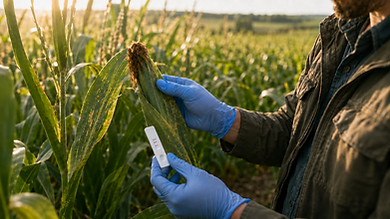
Climate change, international trade and changing agricultural practices are making plant health threats less predictable. Temperature, rainfall and seasonal conditions influence where pests and pathogens survive, when they become active and how quickly they spread. At the same time, the movement of plants, seeds, growing media, grain and other agricultural products can carry biological threats and contaminants into new regions and supply chains.
The Food and Agriculture Organization of the United Nations (FAO) estimates that plant pests destroy up to 40% of global crop production each year, while plant diseases cost the global economy more than USD 220 billion annually. Climate change is also affecting the distribution, severity and behaviour of plant pests, strengthening the case for effective surveillance and earlier warning [1].
Against this background, the timing of a result can be almost as important as the result itself. Laboratory analysis remains essential for definitive identification and accurate quantification, but an earlier indication of risk may allow material to be held, segregated or prioritised before it moves further. Lateral flow assays can provide this screening capability at growing sites, storage facilities, processing plants and inspection points. Although the technology can be applied to many agricultural targets, pathogen proteins and small molecule toxins provide two useful contrasts for understanding the development challenges.
This article follows the path from sample to decision, showing how representative sampling, extraction, assay format, environmental performance and interpretation shape the reliability and usefulness of a rapid result. These elements are closely linked, so development should connect the sample workflow, reagent and bioconjugation strategy, strip design, performance verification and transfer to manufacture from the start.
How Rapid Lateral Flow Tests for Plant Health Support Earlier Decisions
Laboratory methods are required where detailed identification, accurate quantification or an officially recognised result is needed. Lateral flow assays add a complementary screening layer at locations where action can still be taken. Depending on the application, a rapid result could help to:
Refer suspicious plant material for specialist identification or temporarily segregate it.
Screen incoming grain, feed or another commodity before processing.
Prioritise samples for confirmatory analysis or determine whether further sampling is required.
Monitor an established risk across sites or sampling periods.
The value lies less in replacing laboratory analysis than in improving what happens before it. Earlier screening can direct specialist resources towards the most relevant samples and shorten the time to the appropriate next action.
This approach supports the aims of the United Kingdom’s International Action Plan for Plant Health 2026 to 2030, which highlights timely pest identification, stronger diagnostic networks and electronic exchange of plant health data [2].
The role of the test determines the evidence it needs. An assay used to prioritise samples for laboratory confirmation has different performance requirements from one used to decide whether material should be moved, segregated or processed further. Requirements may also vary with the application, intended use and target market.
Before development begins, the intended user, sample type, testing location, decision threshold and next action should therefore be clear. Together, these define where the rapid result sits within the wider decision process and the performance it must deliver.
Sampling and Extraction Determine What Can Be Measured
Agricultural samples are often heterogeneous. Before a lateral flow assay can measure anything reliably, the material collected must represent the plant, commodity lot or production area. It must then be converted into an extract that releases the target without preventing the strip from functioning correctly.
Representative Sampling
Plant pathogens may be concentrated in particular leaves, lesions, roots, vascular tissues or areas of new growth. Testing an unaffected region can therefore produce a negative result even when infection is present elsewhere.
Mycotoxin contamination creates a similar problem across a batch. Fungi and the toxins they produce may occur in small pockets within a much larger quantity of grain or feed. Material collected from one point in a bag, silo or vehicle may therefore not represent the wider lot.
A sufficiently large sample may need to be assembled from multiple increments collected across the plant, production area or commodity batch. The combined material must then be mixed and reduced carefully so that the smaller portion used for extraction remains representative.
Sample size, homogenisation and subsampling are part of the analytical method, not simply sample handling. Studies of mycotoxins in cereal shipments show that sampling and sample preparation can contribute substantially to total measurement uncertainty, particularly where contamination is unevenly distributed [3].
The procedure should define where material is collected, the minimum sample mass or number of increments, how the combined sample is homogenised and how it is reduced without introducing avoidable bias. It must be rigorous enough to support the intended decision while remaining practical for consistent use.
Producing an Extract the Strip Can Use
Representative collection is only the first stage. The preparation method must release the target while controlling the amount of matrix material transferred to the strip.
Plant tissue, grain and feed may need grinding or other mechanical disruption. If the material remains too coarse, the target can stay trapped within intact particles. Grinding too finely, however, can release starch, oils, pigments, fibres, enzymes and cellular debris that increase viscosity or interfere with antibody binding and capillary flow. Development must therefore balance target recovery against the amount of matrix released, with suitable controls for particle size, sample mass, grinding method and extraction time.
The ratio of sample to buffer requires a similar balance. Too little buffer may produce a concentrated but viscous or highly interfering extract; too much may improve flow while diluting the target outside the useful detection range.
Extraction chemistry must also remain compatible with the lateral flow system. Detergents, salts, chelators or solvents may improve recovery and target stability but reduce antibody binding, destabilise detector particles or alter membrane migration. Solvent tolerance is particularly relevant to mycotoxin and other small molecule assays.
Strip design can also help manage difficult matrices. Filter or pretreatment pads can hold back larger particles, control sample entry or reduce membrane blockage. Treatment buffers can manage pH, ionic strength, wetting, viscosity and nonspecific binding. These measures still need to be balanced because filtration may improve flow but retain material containing the target, while an additive that improves extraction may impair antibody or conjugate performance.
Testing representative matrices during feasibility allows the preparation method and strip design to be developed together. This provides a stronger foundation than an assay optimised in buffer that later proves unable to tolerate the intended sample.
Choosing the Right Assay Format
The appropriate lateral flow format depends on the size, structure and available binding sites of the target. Pathogen proteins and small molecule toxins illustrate why a single assay design cannot serve every agricultural application.
Pathogen Proteins and Sandwich Detection
Many pathogen assays detect proteins or antigens with more than one accessible binding site. These may suit a sandwich format, in which one reagent captures the target and a second labelled reagent provides detection. Within the assay’s working range, a higher target concentration will generally produce a stronger test line signal.
Antibody selection should take place under lateral flow conditions. A pair that performs strongly in an equilibrium assay may bind too slowly during capillary migration or lose performance after conjugation and immobilisation.
Representative target material should also be introduced early. A purified recombinant protein may not reproduce the epitope accessibility, aggregation or matrix association seen when the target is extracted from infected plant tissue. The preferred antibody pair is therefore the one that retains specificity and produces a useful response across representative samples, target concentrations and operating conditions, rather than simply the pair with the strongest signal in buffer.
Small Molecules and Competitive Detection
Many toxins, pesticide residues and other small molecules cannot bind capture and detector antibodies simultaneously. They commonly require a competitive format, in which increasing analyte concentration produces a decreasing test line signal.
For toxin assays, hapten bioconjugation can be central to performance. A toxin or related analogue may be coupled to a carrier protein for antibody generation, test line immobilisation or tracer preparation. The attachment position should preserve the structural features required for recognition, while the linker should present the hapten without becoming a dominant part of the antibody response.
The ratio of hapten to carrier also needs to be controlled. Too little hapten may produce a weak signal; too much can reduce accessibility, increase conjugate heterogeneity or compress the useful region of the competitive curve. The objective is not maximum loading, but a reproducible conjugate that provides the required curve shape and inhibition range around the decision threshold.
This is why bioconjugation and lateral flow development benefit from remaining closely connected. Relatively small changes in hapten presentation can significantly affect sensitivity, specificity and the useful part of the response curve.
Performance in the Intended Environment
Agricultural assays may be stored and operated in glasshouses, vehicles, warehouses, grain intake areas or outdoor inspection sites. Their environmental requirements should reflect the season and geography in which they will be used.
In July 2026, the World Meteorological Organization reported that western Europe had experienced its hottest June on record. Temperatures exceeded 40°C at several locations in Spain, illustrating conditions that field and intake testing may encounter in southern European markets [4].
A kit intended for these environments must retain performance during distribution and storage, sample preparation and strip operation. Each stage places different demands on the system and should be represented during development.
Protecting the Kit Before Use
Heat and moisture can affect dried conjugates, immobilised proteins, membranes, liquid buffers, adhesives and cassette materials. Packaging should therefore be selected to suit the intended shelf life, distribution route and likely temperature excursions. The right solution may combine a more stable reagent formulation with high barrier pouches, reliable seals, suitable desiccants, secondary packaging or defined transport and storage limits.
The final kit configuration should be supported by accelerated and real-time stability studies, together with temperature excursion studies relevant to the proposed markets. Packaging choices should reflect the complete system rather than rely on a standard configuration.
Maintaining Performance During Testing
Temperature can alter sample viscosity, extraction efficiency, antibody binding kinetics, conjugate release, membrane flow, background and signal intensity. The effect depends on the assay and may change both the magnitude and shape of the response.
In a competitive assay, for example, temperature may shift the midpoint or slope of the inhibition curve relative to the decision threshold. Two antibodies that perform similarly at 20–25°C may show different backgrounds, affinities or curve stability at 35–40°C.
Reagent screening and optimisation should therefore include temperatures expected during use. Depending on the result, development may involve selecting antibodies with more stable curve behaviour, adjusting conjugate or test line loading, refining the buffer or adding a defined sample conditioning step.
For assays that use a reader, operating temperature can also form part of the interpretation model. Where a systematic effect has been characterised, the reader may apply a validated threshold or calibration curve adjusted for temperature. This approach depends on a reproducible assay response and verification with representative samples, devices and manufacturing lots.
Reader Based Interpretation and Connected Monitoring
Visual interpretation remains appropriate where a clear binary result is sufficient. Readers become more valuable where signals are weak, quantitative, competitive or multiplexed, or where results must be compared consistently across users, sites and sampling periods.
An optical reader or smartphone application may capture the result image alongside information such as sample and lot identifiers, location, test batch, read time and operating temperature. This creates a structured record that can be transferred into laboratory, quality or surveillance systems.
Teams can then compare results from different sites or sampling periods, investigate potential clusters and direct confirmatory sampling towards areas of greater concern. This could complement the diagnostic networks and electronic plant health information described in the UK International Action Plan.
A rapid screening result would not replace an official laboratory identification or phytosanitary certificate. It could, however, improve the speed and consistency of the information available to those systems. Considering signal range, read time, cassette geometry, calibration and data requirements during assay development also simplifies later integration with a reader.
Converting Rapid Results into Better Decisions
The route from sample to decision is only as strong as the connections between its stages. Treating sampling, extraction, environmental performance and manufacture as parts of one system gives a promising strip a stronger route into practical use.
Experience adds value because many of the most important choices are made early. Knowing which variables to challenge, which compromises are acceptable and how each part of the system affects the rest keeps development focused and builds a stronger path to the intended use.
Fleet Bioprocessing combines specialist lateral flow and bioconjugation expertise with the practical work needed to optimise, stabilise and transfer an assay to manufacture. Support can be tailored to a single technical challenge or a complete development programme, while keeping the final product and the decision it needs to support in view.
ISO 13485 is not a product requirement for the agricultural assays discussed here. However, Fleet Bioprocessing’s ISO 13485 certified quality management system provides an added advantage by bringing control, traceability and consistency from design inputs through development and across the product lifecycle. Tailored to the needs of each product, this supports a robust, reproducible test designed for real samples and operating conditions, with a clear route to reliable production.
Learn more about Fleet Bioprocessing’s Lateral Flow Assay Development services, including Proof of Concept, Feasibility, Optimisation, Performance Verification, Stability Studies and Transfer to Manufacture, or contact our team to discuss how we can support your assay development programme.
References
[1] Food and Agriculture Organization of the United Nations. Climate change fans spread of pests and threatens plants and crops—new FAO study. 2 June 2021. https://www.fao.org/newsroom/detail/Climate-change-fans-spread-of-pests-and-threatens-plants-and-crops-new-FAO-study/en
[2] Department for Environment, Food & Rural Affairs. United Kingdom’s International Action Plan for Plant Health 2026 to 2030. 25 June 2026. https://www.gov.uk/government/publications/united-kingdoms-international-action-plan-for-plant-health-2026-to-2030/united-kingdoms-international-action-plan-for-plant-health-2026-to-2030
[3] Bourgeois FS, Lyman GJ. Quantitative estimation of sampling uncertainties for mycotoxins in cereal shipments. Food Additives & Contaminants: Part A. 2012;29(7):1141–1156. https://doi.org/10.1080/19440049.2012.675594
[4] World Meteorological Organization. Western Europe has hottest June on record. 9 July 2026. https://wmo.int/media/news/western-europe-has-hottest-june-record


