

Rapid Antibody Screening for Immunoassay Development
Updated: Jul 6
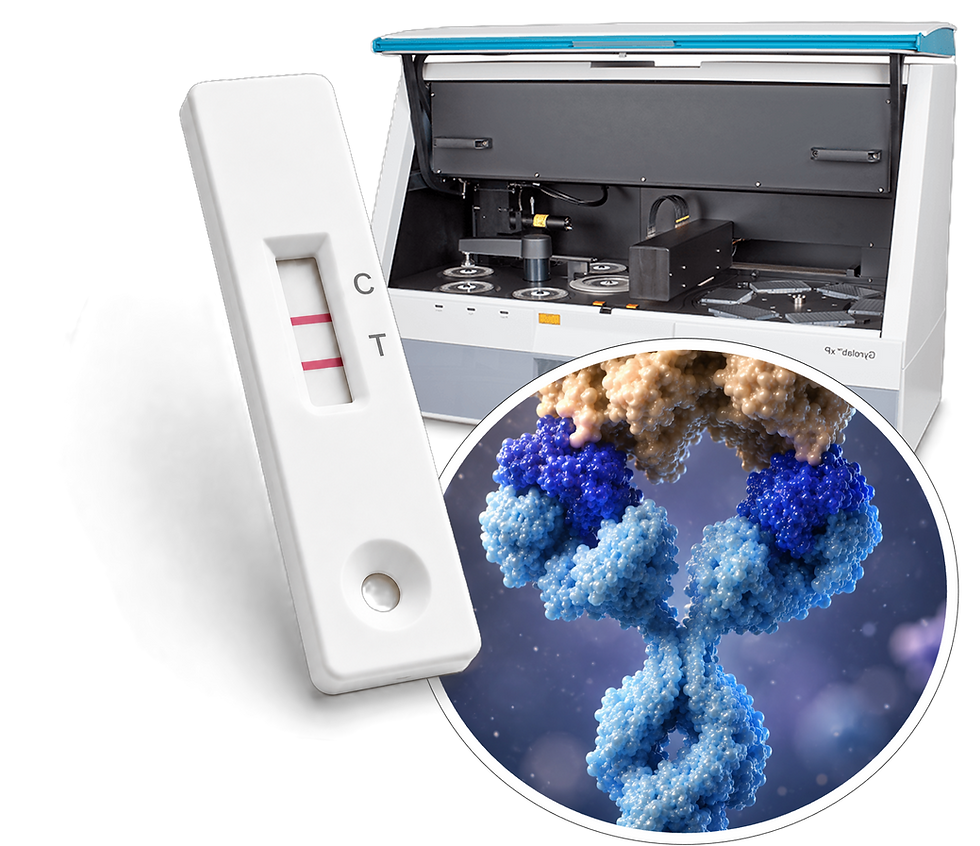
Antibody selection is one of the most important early decisions in immunoassay development. The right antibody candidate can influence assay sensitivity, specificity, reproducibility, matrix tolerance, format compatibility and long term performance.
Poor antibody selection can create issues later in development, including weak signals, non specific binding, inconsistent reagent performance or difficulty transferring the assay into the final format.
Fleet Bioprocessing supports Rapid Antibody Screening across Lateral Flow, ELISA, Gyrolab™ and other immunoassay formats. Our approach is designed to help identify stronger antibody candidates earlier, using screening conditions aligned to the intended assay format rather than relying on generic binding data alone.
As part of this format aware approach, Gyrolab™ can be used as a rapid, low volume screening tool to help rank larger antibody panels and reduce them to a smaller pool for platform specific evaluation. Where appropriate, this can include affinity informed comparison using parameters such as Kd values, while final antibody selection remains guided by performance in the intended assay format or platform.
Applications
Rapid antibody screening can support a wide range of immunoassay development projects, including Lateral Flow Assay Development, ELISA and Plate Based Immunoassays, Gyrolab™ and other Automated Immunoassays, Pharmacokinetic (PK), Pharmacodynamic (PD) & Biomarker assays, Anti-drug Antibody (ADA) Immunoassays and Companion Diagnostic Immunoassays.
Screening with Small Antibody Quantities
Early antibody screening is often constrained by the amount of antibody available, particularly where candidates are newly generated, expensive, difficult to express or supplied in restricted quantities.
Fleet’s antibody screening service is designed to evaluate candidate antibodies under assay relevant conditions, including binding behaviour, format compatibility and, where appropriate, capture/detector pair performance. By working with very small antibody quantities, broader panels can be screened earlier, helping preserve valuable reagents and reduce the amount of material committed to candidates or combinations that are unlikely to progress.
This allows clients to compare more options before full assay development, focus effort on the most promising candidates and avoid using limited antibody stock on routes that may later fail due to poor signal, specificity, matrix compatibility or conjugation performance.
Bioconjugation and Labelled Reagent Options
A key advantage of working with Fleet is the ability to connect antibody screening with our in-house Bioconjugation expertise. Rather than treating conjugation as a separate downstream step, antibody candidates can be considered alongside the labelling, immobilisation or detection strategy likely to be used in the final assay.
Depending on the intended format, Fleet can support custom conjugation options including biotinylated antibodies, fluorescent antibody conjugates, enzyme conjugates, nanoparticle conjugates and other labelled detection reagents.
Where required, Fleet can also support screening approaches using labelled antigens or antigen-carrier conjugates, such as antigen-BSA conjugates. This can be useful where assay design requires improved antigen presentation, immobilisation or compatibility with a selected detection system.
Why Early Antibody Screening Matters
Antibody screening is not just a selection step; it is a way to reduce risk before full assay development. Format aware screening helps identify candidates that are more likely to perform relevant assay conditions, rather than only demonstrating binding in a generic format.
This supports more confident progression into Proof-of-Concept, Feasibility, Optimisation or Transfer, while helping reduce rework caused by poor conjugation behaviour, weak signal, limited specificity, matrix interference or supply constraints.
For pharma, biotech and diagnostic development teams, this is particularly important where assay performance, critical reagent consistency and development timelines are closely linked.
Why work with Fleet
Fleet brings more than 25 years of immunoassay development experience across multiple platforms, in house custom bioconjugation expertise and a track record of developing hundreds of assays across diverse applications.
This combination allows antibody selection to be considered alongside assay format, critical reagent design, conjugation chemistry and downstream development requirements. The result is a more integrated approach, helping clients make better decisions before moving into assay optimisation or transfer.
Talk to Fleet about antibody screening for your immunoassay development project.


